Powering Europe’s Security: Industry and Defence Leaders Meet in Ostrava
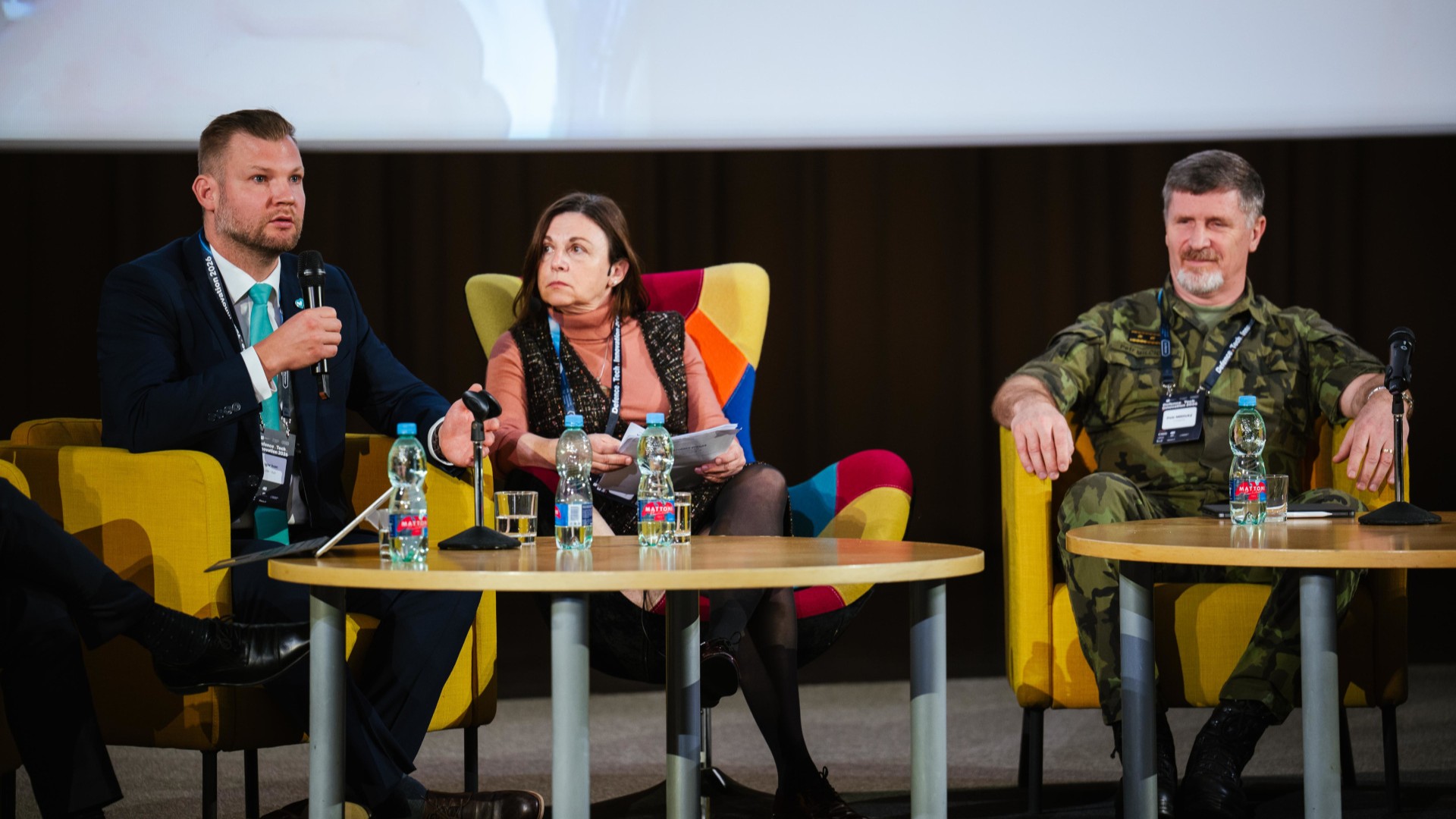
On 24 March, Ostrava hosted the Defence Tech Innovation 2026 conference, a strategic platform co-organised by the Confederation of Industry of the Czech Republic, VSB–Technical University of Ostrava and BeePartner. Bringing together industry, research organisations, government and academia, the event focused on a single question: how to ensure that Czech industry becomes a key player in defence technologies and innovation.
Modern security is no longer confined to the battlefield
Since 2022, Europe’s security can no longer be taken for granted and is no longer the exclusive domain of the armed forces. Modern conflicts also unfold in energy systems, supply chains and cyberspace. Today’s security risks stem not only from external threats, but also from our own vulnerabilities – slow investment processes, technological lag, insufficient coordination and a limited ability to respond to new challenges.
Czech companies have strong innovation capacity, but they are slowed down by procedures, certifications and regulatory burdens. In a security environment that is changing dynamically, delays in procurement, slow deployment of technologies or excessive bureaucracy are not only economically costly – they constitute a serious security risk. It is therefore essential to speed up the transfer of innovation into practice and remove unnecessary administrative barriers.
“We are able to develop new technologies very quickly today. What holds us back are not ideas or skills, but procedures, approvals, certification and excessive regulation. If we want to remain competitive, we need to test and deploy new technologies within months, not years,” said Lumír Srch from ITS at the conference.
A state’s security capacity is defined not only by the number of troops and military equipment, but also by its ability to respond quickly and the resilience of its economy.
“Every crown invested in defence technologies has a secondary effect on the civilian economy – in innovation, exports and jobs,” said Milena Jabůrková, Vice-President of the Confederation of Industry of the Czech Republic responsible for defence and preparedness, cyber security and the digital economy.
Czech Republic must help shape the rules
Europe is investing heavily in defence and technological resilience, creating a major opportunity for Czech industry. The future shape of the European defence market and Europe’s security architecture is being defined now, and the Czech Republic needs to be actively involved in these processes – not just implementing decisions taken elsewhere.
Defence innovation does not arise in a vacuum; it is driven by cooperation between companies, research institutions and universities. The conference therefore brought together leading players such as Czechoslovak Group, ITS, IBM and others with academic institutions led by VSB – Technical University of Ostrava, alongside representatives of the public sector.
“European security today rests not only on military strength, but above all on technological sophistication, the ability to innovate rapidly and to connect research with practice effectively. VSB – Technical University of Ostrava has long been building its profile in areas that are key to modern security – from advanced materials, energy and mechanical engineering to information technologies, cyber security and high performance computing, through to environmental and industrial technologies. Our goal is to ensure that research results find their way into practice as quickly as possible and help to strengthen the resilience not only of the Czech Republic, but of Europe as a whole,” explained Rector Igor Ivan, outlining the rationale for the conference partnership.
Inaction is not an option
The Confederation of Industry of the Czech Republic sees defence and resilience as an integral part of the country’s economic competitiveness. In an environment where the United States, Asian economies and Russia are massively investing in defence technologies, active participation in European and allied programmes is a matter of survival in an increasingly competitive global market.
“The conference showed that Czech companies and universities have enormous innovation potential. However, without clear and stable budgetary and strategic support from the state, we risk these companies and researchers going to work for foreign contractors or moving abroad,” warned Milena Jabůrková, Vice-President of the Confederation of Industry of the Czech Republic. She stressed that the Confederation stands ready to help overcome European regulatory barriers and to ensure that innovation is successfully translated into the defence system and the wider economy.
About the Defence Tech Innovation 2026 conference
The Defence Tech Innovation 2026 conference was held on 24 March 2026 in Ostrava. The programme brought together leading experts from the defence industry, the security community, research institutions and public administration. Speakers included, among others, Jan Rafaj (Confederation of Industry), Lumír Srch from ITS, Igor Ivan and Vít Vondrák from VSB–Technical University of Ostrava, Jan Farlík from the University of Defence, and Petr Kavalíř, Government Envoy for Quantum Technologies. Case studies were presented by Martin Švík from IBM and Jan Hamáček from CSG. Other speakers included Robert Králíček, Government Envoy for Digitalisation and Strategic Security, Petr Milčický from the Armed Forces of the Czech Republic and Bohuslav Přikryl from CSG.
The panel on Czech business and its opportunities in NATO and the EU featured Monika Landmanová from the Representation of the European Commission in the Czech Republic, Petr Šimoník from VSB–TUO and Leoš Mauer from NATO DIANA. The university sector was represented by Zdeněk Pokorný from the University of Defence, who joined a discussion with Martin Švík from IBM, Miroslav Stříbrý from the Czech Export Bank and Jan Homola, Adviser for Defence and the Dual Use Sector at the Ministry of Regional Development. A session on accelerating defence capabilities featured contributions from Diana Rádl Rogerová of Semantic Visions, Gabriela Mates of the European Investment Bank, Lumír Srch of ITS, Pavel Tuček of CSG and Radek Martínek of VSB–TUO.
The conference organisers
The Confederation of Industry of the Czech Republic is the country’s largest employers’ organisation, representing the interests of industry and transport in social dialogue, in dealings with public authorities and in European structures. It plays an active role in shaping industrial, innovation and security policies, bringing together thousands of member companies and promoting conditions that support the competitiveness of the Czech economy.
VSB–Technical University of Ostrava has a history of more than 175 years. Its mission is to provide high quality education to all generations and to conduct cutting edge research. The university places particular emphasis on materials science, energy and high performance computing, and strives to ensure that its solutions are developed in line with the principles of sustainable development. It maintains strong links with practice, supports technology transfer and entrepreneurship, and enables students to gain hands on experience and address real world challenges.
BeePartner is a Czech consulting company focused on strengthening the competitiveness of businesses through strategic advisory, grant management and innovation financing. It supports the development of the defence and security industry, the transfer of technologies and the creation of strong international linkages that enhance the resilience and technological autonomy of Czech companies.